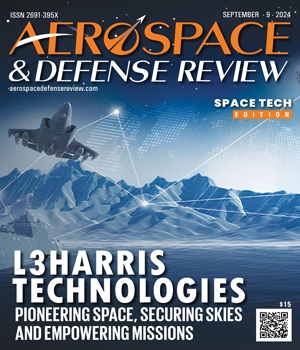
L3harris Technologies: Pioneering Space, Securing Skies And Cover Story Empowering Missions

Top 10 Space Tech Solutions Providers - 2024

Space Tech, once the exclusive domain that facilitated humanity’s quest for the stars, has evolved into a crucial tool for addressing multifaceted challenges on our planet. Earth observation satellites deliver vital data for environmental monitoring, agriculture and disaster management, empowering governments, businesses and researchers to make informed decisions. In parallel, these technologies continue to expand our understanding of the cosmos, driving new discoveries.

Recent reports highlight the growth of the space tech market, valued at $420.2 billion in 2022 and expected to expand at a CAGR of 7.5% from 2023 to 2030. This remarkable growth is driven by a slew of tech developments that enable more ambitious missions and unlock new possibilities for commercialization.

A key factor is the advent of reusable launch vehicles. These rockets, capable of being launched, landed and relaunched multiple times, significantly reduce space access costs and facilitate more sustainable missions. Advancements in AI and machine learning are transforming the industry by enabling real-time decision-making during missions, enhancing efficiency and success rates. The global positioning system (GPS) satellites have transformed navigation and location-based services, providing precise positioning and timing information that supports a multitude of applications.

This edition of Aerospace and Defense Review explores the latest developments in the industry and provides valuable perspectives on how these technologies are transforming space exploration.

It features thought leadership articles from industry experts, including Mike Byham, director operations engineering at American Airlines, who explores the potential of using artificial intelligence to improve aircraft performance engineering. Luigi Taliercio, vice president of operations at Unifi discusses the importance of how their charter business is growing, as they need to always ensure that they have the resources and people to support them.

This edition also spotlights ATLAS Space Operations, a leading provider of ground software as a service (GSaaS) in the space communications industry. Its innovative Freedom™ GSaaS, ATLAS automates communication processes, pre-plans satellite passes and eliminates the need for satellite owners to act as ground station operators.

In this edition featuring the Top Space Tech Solutions Providers of 2024, we hope you find the ideal partner to enhance your organization’s capabilities and stay ahead in the rapidly evolving space industry.
    Top Space Tech Solutions Providers

    L3Harris Technologies
    L3Harris Technologies is a pioneering aerospace and defense company that leverages its centurylong legacy of innovation to develop cutting-edge solutions for space exploration, national security and aviation. From launching spacecraft and enabling secure communications to fortifying missile defense and enhancing aircraft capabilities, L3Harris is shaping the future of technology on Earth and beyond.
    Radiance Technologies
    Radiance Technologies is an employee-owned company that provides innovative solutions to its customers in the intelligence, cyber, directed energy, AI/ML, hypersonics and space industries. The company works to give the U.S. military technological advantages.
    ATLAS Space Operations
    ATLAS Space Operations changed the face of the space communication industry forever by pioneering the concept of Ground Station as a Service. While many saw this as the pinnacle of service, it was just the beginning of ATLAS’s larger vision of providing space operators with uninterrupted, universal access to space. This vision led to the development of Freedom™ Ground Software as a Service (GSaaS).
    Astra
    Astra’s Spacecraft Engine is a cutting-edge propulsion system designed for small satellites, offering efficient, scalable in-space mobility. Leveraging advanced electric propulsion technology, it enables precise orbit insertion and station-keeping. Astra’s engine is ideal for modern satellite missions, providing reliable, high-performance solutions for space exploration and operations.
    Blue Origin
    Blue Origin is advancing reusable launch vehicles and in-space systems that are safe and cost-effective, serving civil, commercial, and defense sectors. Their initiatives include astronaut flights on New Shepard, developing the New Glenn orbital rocket, creating nextgeneration space habitats, and preparing for lunar missions.
    Crane Aerospace & Electronics
    Crane Aerospace & Electronics provides essential systems and components to the aerospace and defense industries. Offering a full range of services from application engineering to design and manufacturing, they excel in delivering both standard products and custom-designed systems with expertise in product specification, certification, and service.
    Dassault Systèmes
    Dassault Systèmes, the 3DEXPERIENCE Company, drives human progress by offering collaborative virtual environments for sustainable innovation. Their 3DEXPERIENCE platform creates virtual twins of real-world systems, enabling customers to redefine creation, production, and lifecycle management, ultimately fostering a more sustainable and human-centered economy.
    FTI
    FTI supports space missions through technology development, advanced science, and systems engineering. Their expertise enhances space domain awareness, sensor modeling, mission simulation, and algorithm development. FTI’s model-based systems engineering (MBSE) practice aids in governance, standards, and hardware systems, ensuring comprehensive support for ground and space operations
    Lockheed Martin
    Lockheed Martin leads in outer space development, collaborating with government and commercial partners to advance space exploration. They design, build, and test technologies for lunar and deep space missions, including NASA’s Orion spacecraft, and develop early-warning weather and climate satellites, such as the GOES-R series.
    Rocket Lab
    Rocket Lab is a leading space company providing end-to-end services, including reliable launch solutions, spacecraft, satellite components, and on-orbit management. Transforming access to space, Rocket Lab’s expertise spans satellite design, manufacturing, space software, and components, driving innovation across the global space economy.

Space Tech Info

Q1
What Do Top Space Tech Companies Do?
Top Space Tech Companies develop the systems, infrastructure and services that support satellite operations, launch programs, space communications, tracking, monitoring and mission support. Their work spans launch vehicles, ground stations, space domain awareness, satellite connectivity, testing environments and orbital monitoring tools. Many organizations depend on these providers to maintain communication with spacecraft, collect mission data and manage increasingly crowded orbital environments. A missed tracking event or communication failure can affect an entire mission. That is why reliability, coverage and technical depth matter as much as the technology itself.
Q2
Why Do Top Space Tech Companies Matter More Today?
Demand for space-based services continues to expand across defense, communications, Earth observation, navigation and commercial research. Top Space Tech Companies are supporting a market that is becoming more active, complex and competitive. Smaller satellites, larger constellations and growing national security requirements are creating pressure on launch schedules, tracking systems and ground infrastructure. Organizations are no longer focused only on getting assets into orbit. They also need dependable mission support after deployment. Ground access limitations, tracking gaps and cybersecurity concerns can create costly disruptions once a satellite is operational.
Q3
How Should Organizations Evaluate Space Technology Providers?
Comparing providers often begins with technical capability, but practical execution is usually what sets them apart. Organizations should look at how a provider manages mission planning, data delivery, system redundancy, security requirements and long-term support. Reviewing the workflow through a realistic mission scenario can reveal much more than a standard product demonstration. It is also useful to understand how the provider handles communication interruptions or unexpected orbital events. Space systems operate in environments where even small delays can have lasting consequences. Documentation quality, compliance readiness and support responsiveness should all be carefully considered during the evaluation process.
Q4
What Business Value Do Space Technology Providers Deliver?
The value extends well beyond satellite deployment. Strong space technology partners help organizations improve visibility, communications, navigation accuracy and mission continuity. Government agencies, defense organizations and commercial operators often depend on uninterrupted access to space-based assets for daily decision-making. Poor visibility into satellite status or delayed mission data can affect planning, security and service delivery. The best providers help reduce those risks by improving tracking accuracy, strengthening communications infrastructure and supporting faster access to mission-critical information. In many cases, reliable support services become just as important as the hardware itself.
Q5
How Are Innovation and Advanced Technologies Shaping the Space Tech Market?
Innovation is changing nearly every part of the space sector. Artificial intelligence, automated tracking systems, advanced sensors and data fusion platforms are helping operators manage larger numbers of satellites and orbital objects. Many Top Space Tech Companies are also investing in scalable ground networks, improved launch systems and more sophisticated monitoring tools. As orbital traffic increases, the ability to identify potential collisions, track assets accurately and process large volumes of mission data becomes increasingly important. Most teams already have access to data. The challenge is turning that information into timely decisions that support mission objectives.
Q6
What Should Decision-Makers Prioritize When Comparing Top Space Tech Companies?
Decision-makers should focus on mission fit rather than broad capability claims. The most useful questions are often practical ones. Can the provider support the required coverage areas? How quickly can it respond during a mission issue? Does the infrastructure scale as satellite deployments grow? Are security controls aligned with regulatory and defense requirements? Top Space Tech Companies are often compared on technology, but long-term performance usually depends on service reliability, support quality and infrastructure resilience. A strong platform can still create problems if communication coverage, maintenance support or tracking accuracy fall short during real missions.