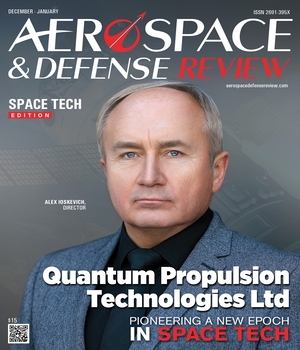
Quantum Propulsion Technologies Ltd: Pioneering a New Epoch In Space Tech

Top 10 Space Tech Solutions Companies - 2023

The final frontier has always beckoned to the human spirit, and we have answered that cosmic call with technology that defies imagination. Space technology, in all its facets, has become a hallmark of human ingenuity and the embodiment of our unquenchable thirst for discovery.

The current trends in space technology are akin to a fast-moving meteor shower, leaving awe-inspiring streaks of progress in their wake. A dominant trend is the rise of private space exploration companies, led by SpaceX and Blue Origin. These pioneers are revolutionizing space travel, making it more accessible, and turning the once-distant dream of commercial space tourism into a reality.

According to Market Research Future, the space technology market size was valued at USD 293.8 Billion in 2022 and is projected to grow from USD 313.4846 Billion in 2023 to USD 526.6614934 Billion by 2032, exhibiting a compound annual growth rate (CAGR) of 6.70 percent during the forecast period (2023-2032).

Space technology extends our reach into the cosmos and touches our daily lives on Earth. Satellite technology has become integral to our modern existence, offering GPS navigation, weather forecasts, and global communication. Earth observation satellites are aiding in resource management, disaster response, and climate analysis, providing invaluable data for the betterment of our planet.

This edition of Aerospace and Defense Review delivers a bird’seye view of recent developments in the space tech area and insights into how organizations align with these trends and adopt lucrative ways to bring the futuristic vision of space tech to fruition.

We have curated thought leadership articles from industry experts, including Alejandro R. Ochoa, Head of In-flight Technology at Aeromexico, and John Davies, Director of Repair Station, at Air Methods.

We also took a deep dive into market trends to narrow down the list of companies delivering robust space tech solutions. Equipped with innovative technological capabilities, companies like Sierra Remote OBSERVATORIES (SRO) help transform businesses at the cloverleaf of various disruptive technologies.

We hope this edition of Aerospace and Defense Review on Space Tech helps you build the partnership you and your organization need to foster an environment driven by efficient technology
    Top Space Tech Solutions Companies

    Quantum Propulsion Technologies Ltd
    Quantum Propulsion Technologies Ltd is developing quantum propulsion systems and space vehicles that will be capable of flying with enormous speed (potentially reaching speed of light) and will have unseen before manoeuvrability and lifting capacity.
    Sierra Remote Observatories (SRO)
    Since the founding of Sierra Remote Observatories (SRO) in 2007, it has been become the premiere destination for automated astronomical data collection and imaging, satellite tracking and space communication. What sets the site apart from various other sites in the U.S. is its exceptional darkness and seeing capability, its unique and accessible location, its robust and redundant infrastructure and fulltime support services.
    Ascending Node Technologies
    Ascending Node Technologies is a Tucsonbased startup that creates technologies to improve collaboration between spacecraft mission planners and operators. The founders of Ascending Node have over a half-century of combined expertise in planning, organizing, and managing interplanetary exploration missions.
    Astra
    Astra enables its clients to Improve Life on Earth from Space® by offering smallsat builders and operators worldwide specialized small launches and mission-critical onorbit mobility. Its world-class team provides extensive technical and commercial knowledge from the emerging space, aerospace, & technology industries.
    BLUE ORIGIN
    Jeff Bezos launched Blue Origin with the idea of allowing a future in which millions of people live and work in space for the sake of Earth. Blue Origin thinks that to save Earth, mankind will need to develop, explore, uncover new energy and material resources, and relocate harmful businesses to the planet into space.
    ICEYE
    ICEYE is a rapidly expanding multinational New Space firm with people from more than 45 countries that share similar values and vision. ICEYE provides unparalleled persistent tracking abilities for any region on the planet. They provide objective, datadriven choices for clients in industries like insurance, natural disaster response and recovery, security, marine surveillance, and finance by owning the world’s biggest synthetic-aperture radar (SAR) satellite network.
    Lockheed Martin Corporation
    Lockheed Martin Corporation located in Bethesda, Maryland, is a global security & aerospace firm specializing in the research, design, development, production, integration, and maintenance of high-technology systems, products, and services.
    Maxar Technologies
    Maxar Technologies is a reliable partner and a pioneer in Earth intelligence & space infrastructure. They provide disruptive benefits to government and business clients by assisting them in monitoring, understanding, and navigating the world of change, providing global broadband communications, and exploring and advancing the use of space.
    Pythom
    Pythom manufactures rockets for orbiting tiny satellites. Pythom Space was a space transportation system development business.
    Rocket Lab
    Rocket Lab is a full-service space corporation that provides dependable launch services, comprehensive spacecraft design and production, satellite components, flight software, and other services. The services and solutions also include mission simulation & ground software solutions for complete spacecraft command and control of all spacecraft & constellations.

Space Tech Info

Q1
What Do Top Space Tech Companies Do?
Top Space Tech Companies develop the systems, infrastructure and services that support satellite operations, launch programs, space communications, tracking, monitoring and mission support. Their work spans launch vehicles, ground stations, space domain awareness, satellite connectivity, testing environments and orbital monitoring tools. Many organizations depend on these providers to maintain communication with spacecraft, collect mission data and manage increasingly crowded orbital environments. A missed tracking event or communication failure can affect an entire mission. That is why reliability, coverage and technical depth matter as much as the technology itself.
Q2
Why Do Top Space Tech Companies Matter More Today?
Demand for space-based services continues to expand across defense, communications, Earth observation, navigation and commercial research. Top Space Tech Companies are supporting a market that is becoming more active, complex and competitive. Smaller satellites, larger constellations and growing national security requirements are creating pressure on launch schedules, tracking systems and ground infrastructure. Organizations are no longer focused only on getting assets into orbit. They also need dependable mission support after deployment. Ground access limitations, tracking gaps and cybersecurity concerns can create costly disruptions once a satellite is operational.
Q3
How Should Organizations Evaluate Space Technology Providers?
Comparing providers often begins with technical capability, but practical execution is usually what sets them apart. Organizations should look at how a provider manages mission planning, data delivery, system redundancy, security requirements and long-term support. Reviewing the workflow through a realistic mission scenario can reveal much more than a standard product demonstration. It is also useful to understand how the provider handles communication interruptions or unexpected orbital events. Space systems operate in environments where even small delays can have lasting consequences. Documentation quality, compliance readiness and support responsiveness should all be carefully considered during the evaluation process.
Q4
What Business Value Do Space Technology Providers Deliver?
The value extends well beyond satellite deployment. Strong space technology partners help organizations improve visibility, communications, navigation accuracy and mission continuity. Government agencies, defense organizations and commercial operators often depend on uninterrupted access to space-based assets for daily decision-making. Poor visibility into satellite status or delayed mission data can affect planning, security and service delivery. The best providers help reduce those risks by improving tracking accuracy, strengthening communications infrastructure and supporting faster access to mission-critical information. In many cases, reliable support services become just as important as the hardware itself.
Q5
How Are Innovation and Advanced Technologies Shaping the Space Tech Market?
Innovation is changing nearly every part of the space sector. Artificial intelligence, automated tracking systems, advanced sensors and data fusion platforms are helping operators manage larger numbers of satellites and orbital objects. Many Top Space Tech Companies are also investing in scalable ground networks, improved launch systems and more sophisticated monitoring tools. As orbital traffic increases, the ability to identify potential collisions, track assets accurately and process large volumes of mission data becomes increasingly important. Most teams already have access to data. The challenge is turning that information into timely decisions that support mission objectives.
Q6
What Should Decision-Makers Prioritize When Comparing Top Space Tech Companies?
Decision-makers should focus on mission fit rather than broad capability claims. The most useful questions are often practical ones. Can the provider support the required coverage areas? How quickly can it respond during a mission issue? Does the infrastructure scale as satellite deployments grow? Are security controls aligned with regulatory and defense requirements? Top Space Tech Companies are often compared on technology, but long-term performance usually depends on service reliability, support quality and infrastructure resilience. A strong platform can still create problems if communication coverage, maintenance support or tracking accuracy fall short during real missions.